In this article
Your AI Agents Are Only as Good as What They Remember
AI agents are only as reliable as what they know. A context graph gives them your team's accrued wisdom—so they act instead of guess.

By Alok Shukla
Cofounder and CEO
Aug 07, 2026
4 min read
Last Updated: Aug 07, 2026
Why the context graph beneath your AI agents matters more than the agents themselves — a note for customer success leaders.
Picture a CEO trying to run a company alone. No matter how capable, they can't — so they build an executive team. Each leader brings deep context and hard-won judgment about their function, and the CEO relies on that accrued wisdom to make good decisions, fast.
Your best CSMs are the same story, one level down. When a great CSM opens an account, they aren't just reading a dashboard. They're drawing on everything they carry in their head: who the stakeholders are, what was promised last quarter, which play worked the last time this customer went quiet, why the renewal almost slipped. The data tells them what is happening. Their accumulated wisdom tells them what it means — and what to do about it.
Now we want AI agents to take on some of that work: spot a risk, investigate it, and either recommend the next move or make it. It's a good idea. But here's the part most teams miss:
An AI agent needs the same context and wisdom your best CSM carries in their head. Signals alone are not enough.
Hand an agent a churn prediction and nothing else, and it's a new hire on day one — technically capable, completely without context. It doesn't know what you already tried, what you promised, or how this customer behaves. So it does what any ungrounded system does: it guesses.
Two kinds of wisdom
The wisdom a great CSM carries comes in two forms, and an agent needs both.
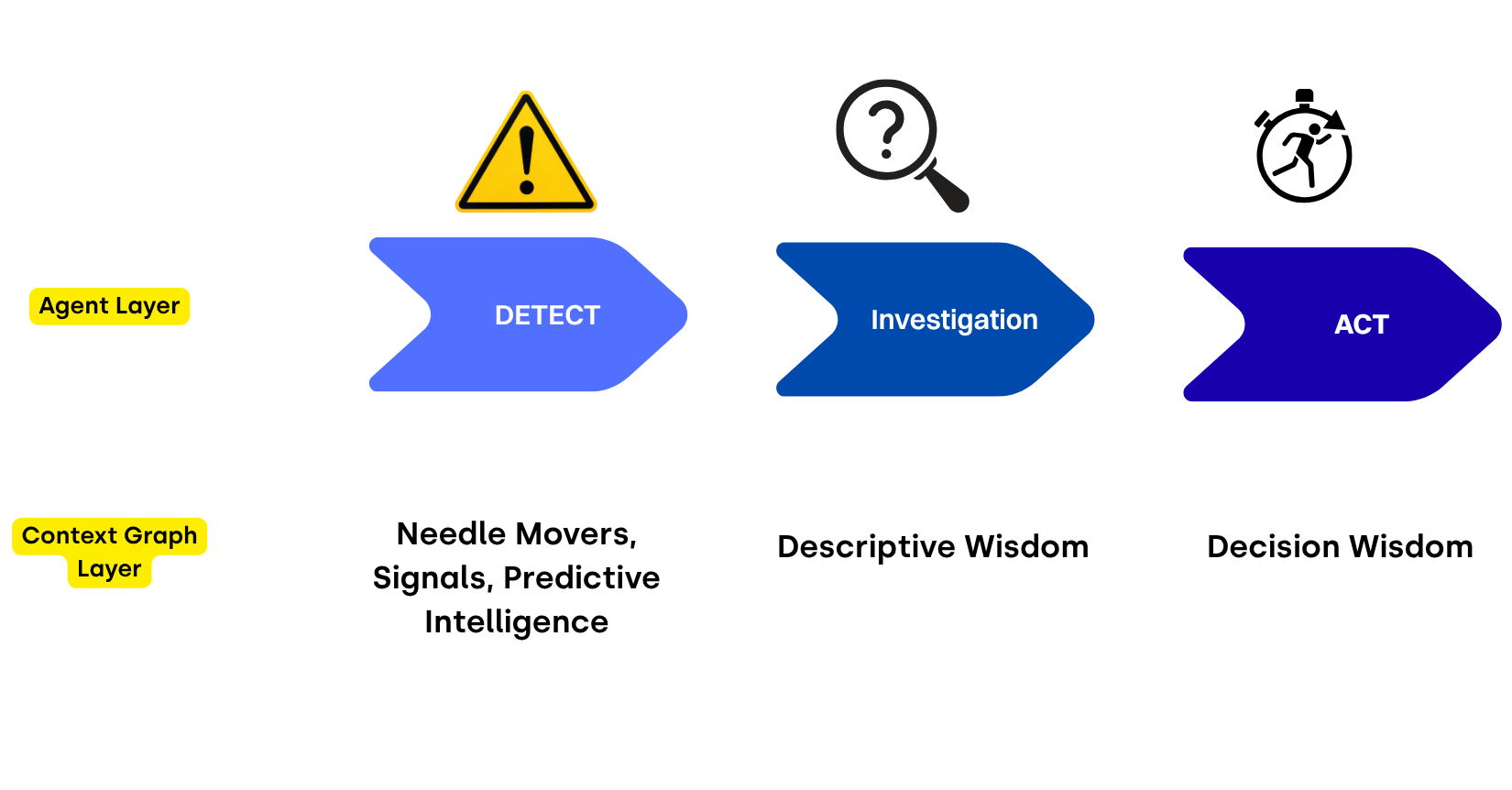
Descriptive wisdom is the memory of what's true about the account right now — the stakeholders and their roles, the current concerns, the positive signals, the long arc of the relationship. State.
Decisioning wisdom is what a great CSM tracks to a resolution over time — what we promised and whether we delivered, what we tried and whether it worked, the value the customer actually realized, how we won the last renewal, and why an account slipped away. Cause and effect.
Most tools do not offer either of them. AI Agents have to guess it for themselves, and they mostly fail. CSMArena Index estimates that AI Agents regularly fail in 40-60% of their tasks. While the first type of wisdom is important. The second is where the real judgment lives — and it's exactly what lets an agent act like your best person instead of your newest one.
The context graph is what holds it together
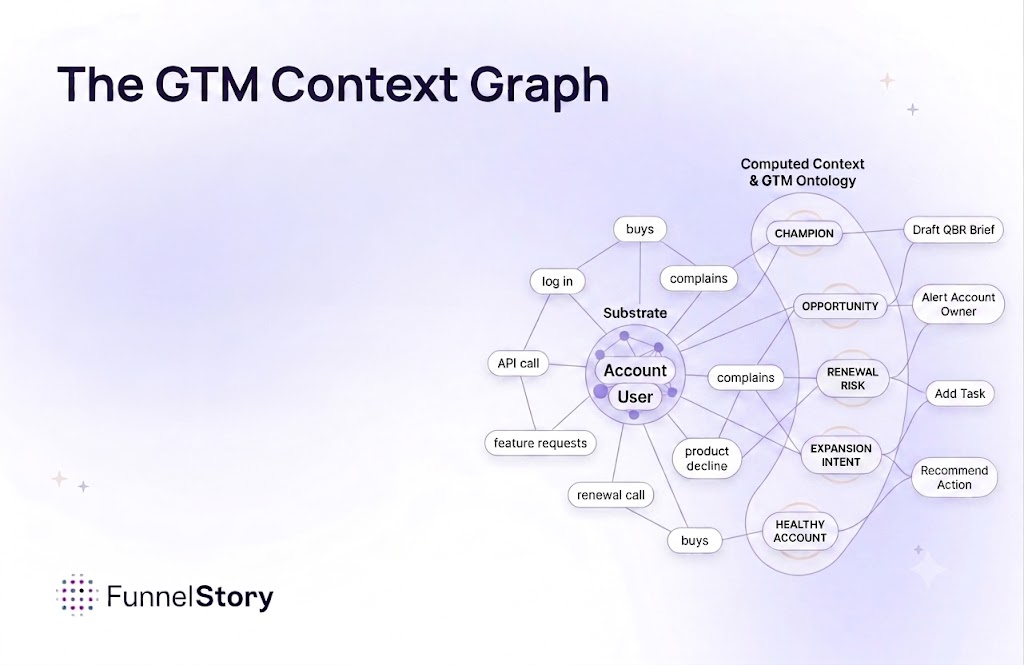
A context graph is the layer that assembles all of this in one place and keeps it current. It pulls raw data from across your stack — CRM, product usage, support, every customer conversation — and turns it into a living, connected picture of each account. Not a static report, but an understanding that compounds: every new conversation, outcome, and renewal makes it sharper.
That's the difference between data and wisdom. Data is what you have. Wisdom is what you've learned. The context graph is where the learning accrues.
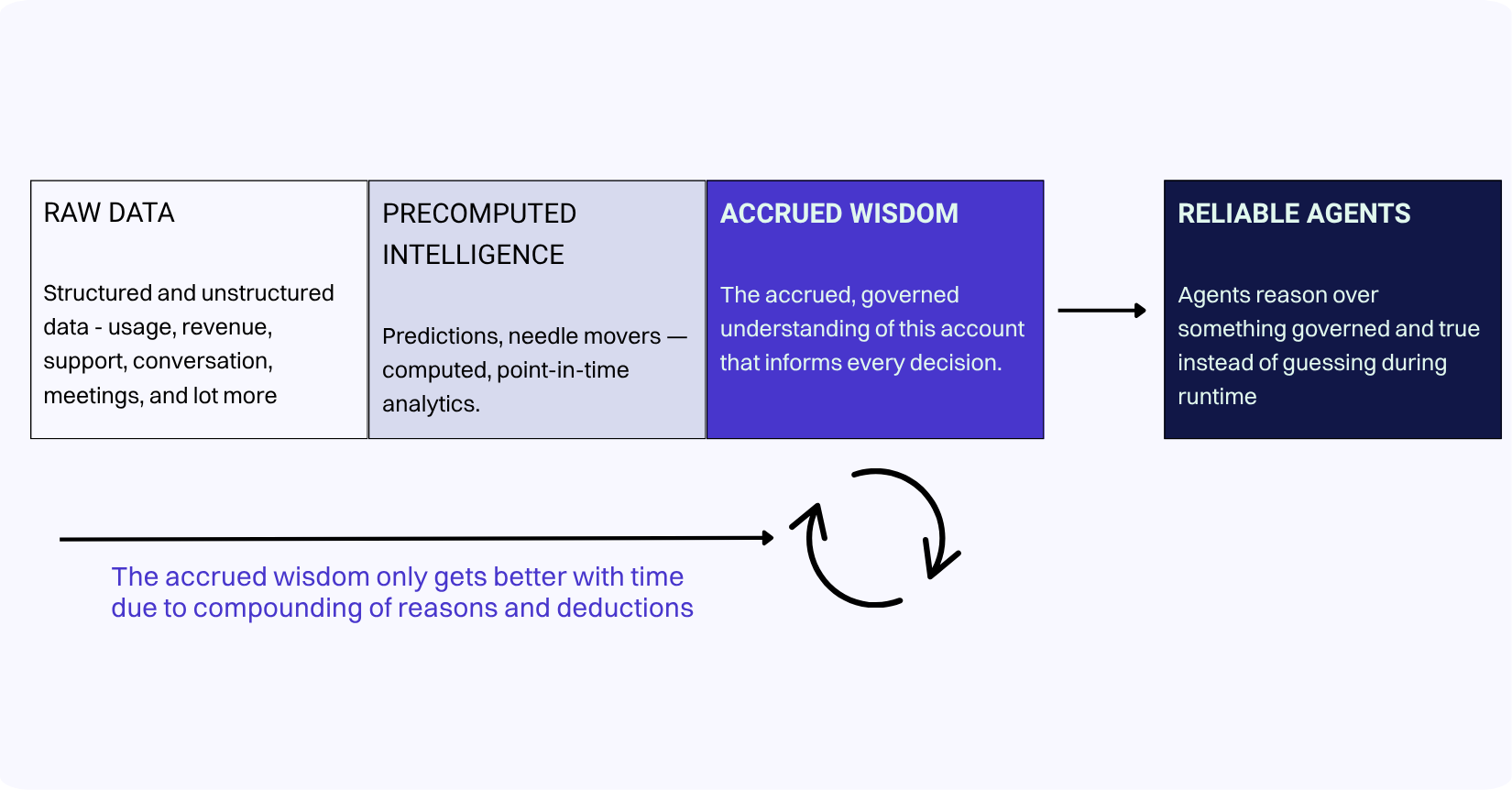
Raw data becomes intelligence, then accrued wisdom — the foundation that lets agents reason over something governed and true, and it compounds over time.
Why this is the whole ballgame
A CS agent can detect, investigate, and act — but every step is only as reliable as the context layer beneath it.
Grounded in a context graph, an agent reasons over something governed and true — the same shared, sourced reality your team already trusts. Without one, it reasons over whatever it can scrape together in the moment.
Running an AI agent without a context graph is like handing someone a warehouse of unsorted books and asking them to answer a customer's question by the end of the hour. They'll find something — but you won't know if it's the right thing, and neither will they. That's how you get confident, well-written, wrong answers in front of your customers.
The real decision
The question for a customer organization is no longer whether to put AI agents to work. It's what those agents are standing on.
Agents built on a context graph inherit your team's accrued wisdom and get better every quarter. Agents built on raw data inherit nothing and guess every time. Same demo — very different outcome six months in, and your customers feel the difference.
So before you trust an agent with a customer relationship, ask one question: does it know what your best CSM knows? If the answer runs through a context graph, you have something you can rely on. If it doesn't, you have a very fast guesser.